Author: LaurenPBurka

  • The Indie Author Click Machine, Part 2

    The Indie Author Click Machine, Part 2

    Let’s read some logs!

    In order to make use of web-based tools—and to diagnose and fix any problems—it helps to understand what normal behavior looks like.

    That’s my excuse for reading my logs obsessively. The other reason is that my entire collection of tools resembles a slow-moving strategy game, and I enjoy the dopamine hits from seeing the wheels go ’round.

    In this post, we’re going to do a deep dive into reading my website logs. If this level of detail doesn’t interest you, it’s OK to go read something with sex in it instead.

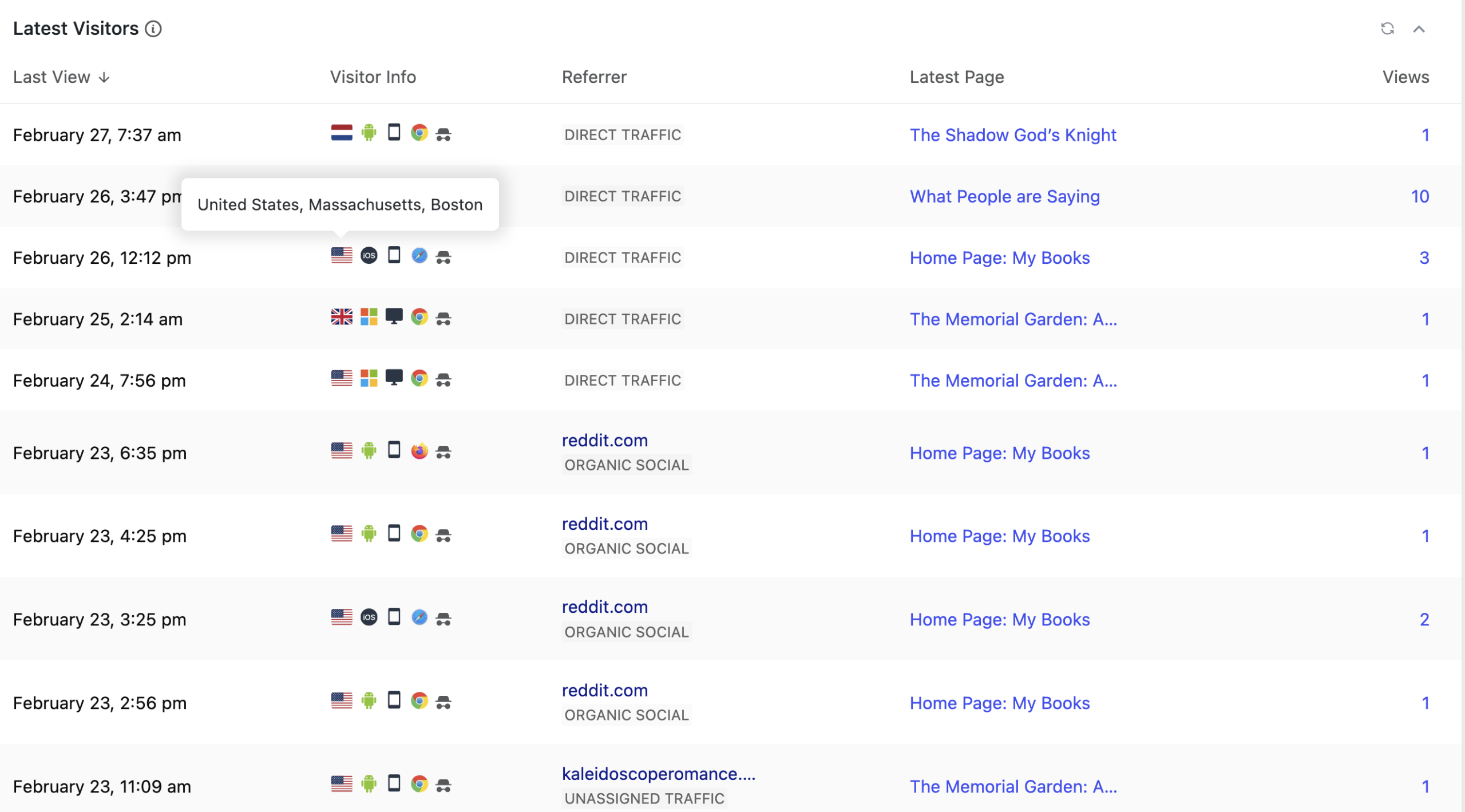
    The screenshot in the featured image slot is from my WordPress logs as rendered by the free version of the plugin WPStatistics (I prefer one that doesn’t use Google). I almost never look at the console logs that report every last connection to my web site. Why?

    • The console log includes the hits generated when I view or update something on my site. That’s a lot of hits. My WordPress log filters out my own traffic.
    • Also not visible here is the constant flood of bots looking for security holes to exploit. I don’t need to see every time someone twists the knob to see if I left the door unlocked, which in practice means being dumb enough to have an account named “admin” with password “admin.”
    • WPStatistics, even the free version, allows me to filter out some traffic. For instance, I filter out the entirety of Singapore, because those hundreds of hits are probably all from AI-scraping bots. Apologies to those of you who are reading this from Singapore right now.
    • The WPStatistics package hashes (obscures) the IP address. I like knowing about my visitors, but your IP address is Too Much Information.
    • My hosting company keeps seven days of raw logs. I did not in fact know that until I went to write my privacy policy, at which point I looked it up. WPStatistics keeps the aggregated statistics for longer than that.

    Let’s look at this log snapshot column by column. Yes, I know that the graphic is oddly cropped. I’m still tinkering with it. Take my word for it on things you can’t see.

    Latest View

    This is a date and timestamp recording the last hit from a visitor.

    The only interesting thing to say about Latest View is that I had this plugin running for about a year before I noticed that I could set the timezone. Thus until recently I had to do the math for the offset from GMT.

    Visitor Info

    Most of this information is populated from the useragent string that is a standard browser feature. Want to know what your browser has to say about you? Look up “useragent” in DuckDuckGo (click on this link.)

    Let’s take the icons in this dense row in order.

    • Location, expressed as a country flag. You can see the mouseover of one here: United States, Massachusetts, Boston. Bear in mind that the internet does not, in fact, know where your house is. It only knows the location reported by your network provider, which may be close or far away. If I look at my site from my phone, the location is reported as Holyoke, MA, a city that is 78 miles / 126 km from mine. Sometimes a log entry has a country flag and reports “Region/City not set,” which probably but not always means it’s a bot.
    • Operating System expressed as a familiar icon. The typical ones are Android, iOS, MacOS, Windows and Linux. If the hit is from a bot, it will probably say Windows, though occasionally bots report they are Linux. Nothing forces a device to tell you what it really is. Back in the day when people rudely programmed their sites to only work in Internet Explorer and gave you an error otherwise, you could use a browser plugin to say you were using IE even if you weren’t.
    • Device type, expressed as icons for desktop, smartphone or tablet. If you’re on a laptop, you’ll appear as a desktop. Strange, but true.
    • Browser used to connect, expressed as an icon. The usual suspects are Chrome, Firefox, and Safari. Almost nobody uses Edge. Some people use the Chinese browser Yandex. Mousing over these icons will tell you what version of the browser is being used and whether it’s mobile or desktop. Sometimes you see a little question mark in a circle, which means there is no icon. There will be a description, though. A typical oddball is “headless Chrome,” which indicates some sort of automated process, i.e. a bot. The really interesting thing for me is that there are so many versions of Chrome that the version makes is possible to tell that entries with different hashes (see next item) are actually the same user. Bots are almost all using old versions of Chrome. If a bot is not using Chrome, it will probably lie and say that it is, because everyone wants to be one of the popular kids.
    • Then there’s the little hat and sunglasses icon for the user hash, which is a mathematical function of the IP address and other information. This makes it possible to track individuals even when I can’t see their IP address. If you visit my site on two different days, you will get two different hashes and appear to be two different people. That’s fine by me. The information here is good enough for me to see what’s going on.

    Referrer

    This field tells me what people were looking at when they clicked a link that goes to my site. This is very valuable information, or would be if it said a bit more.

    Most of the entries say “Direct Traffic,” which is supposed to mean that someone typed the address into the address bar. Yet almost nobody does that. Direct Traffic will show up if someone clicked the link they received in email.

    You can see multiple instances of reddit, where I hang out when avoiding real work. May as well make a virtue of it. Sometimes I get traffic when I post in book discussions on r/femalegazesff or r/queersff, but most of my reddit-related traffic happens when I get in an argument with someone on r/boston. I also sometimes get referrals from posts I make to BlueSky.

    At the bottom, you can see a hit referred by kaleidoscoperomance.com. That’s a cross-promotion with another author who puts together newsletters of related fiction. Check them out!

    The log plugin helpfully keeps separate track of which search engines people use to find my site, which would be more interesting if paying for search engine ranking was at all useful for a small author (it’s not).

    Views

    The final column is the number of views. Clicking on that number brings me to a list of pages the visitor clicked on, in order. Often they go back and forth a few times.

    Some Conclusions

    There’s a lot more to the logs, but I’ll summarize the important bits for you.

    • The oft-cited statistic for the web is that 70% of the traffic is mobile. My total is 38% smartphone and 35% desktop, the balance being tablets and headless devices. The smartphone traffic is probably all real people, the balance of it less so. The web is full of bots. Not all of them are evil. Search engine indexing is done by bots. But many of them are.
    • Almost nobody looks at my blog posts, including this one.
    • Most people who visit my site look at the front page and then wander off.
    • A few people go to other parts of my click machine, including my Patreon or the signup for my newsletter, where they can get a free book in exchange for their email address. More on these next post. Some visitors run off and buy a copy of my books from one of the online retailers currently selling them.

    What’s missing?

    If you were paying attention, you might see that I’m guessing what generates any individual click: reddit or bsky posts, newsletter swaps, links shared on Discord. I could nail down the details by using tracking links. There are WordPress plugins that will generate unique links. I could therefore use one link on a social media post and another link in a newsletter.

    In practice, I don’t have much traffic. Tracking links are too much work and too intrusive for what they’d get me. Also, I have some other pieces that are more informative.

    More on my newsletter and book landing pages next post.
  • The Indie Author Click Machine, Part 1

    The Indie Author Click Machine, Part 1

    If you’re an indie author, you’ve probably heard that a web site is essential. If you’re not, you may wonder what I’m talking about. If you don’t need to know how all the moving parts of this site you’re currently viewing fit together, you may still enjoy reading about how it works and why I made the decisions I did.

    Social media accounts are no replacement for owning your own web site with your own domain, controlled by you. Social media sites will censor you or drown your posts under infinite AI pics of cats with bread on their faces. If you have your own site, you can always post links to it on any social media platform you happen to be using that week. When that site becomes a useless pit, as they do, you can move on to the next one with minimal effort.

    What do I mean by owning your site? You need to have all the passwords. Your name must be on the hosting provider’s records and the domain name registration. You need to know how it works well enough to edit the content. Sure, have a relative help you set it up and get started. But I can’t count the number of times I’ve had someone cry on my shoulder because their helpful relative set up something that they don’t have the permissions or the technical knowledge to change. That means any updates must wait until that other person has time to get to it. Whenever that is.

    You’ll notice that I mentioned a hosting provider. I pay Dreamhost.com $100/year to host my web site. Did you just read that number and gasp, thinking, “I don’t even make that much a year from my writing! My sister offered to set a site up for free on a spare computer in her house.” That’s certainly a valid choice, but my advice is not to take her up on it. Hardware dies. Is your sister backing up that computer? Has she done a test restore to make sure the backups are working? How reliable is the power to her house and neighborhood? Will you cope if her cable company blows her off the net for two weeks while doing necessary maintenance?

    You can always split the difference: take your sister up on her offer of setting up the web site and then migrate it to hosting later. Make sure you know how migration is going to work.

    My site is hosted in a professional data center. If there is a problem, I often get email informing me that it’s been fixed before I notice anything wrong. If I have a question, I can send email and expect a helpful answer within a couple of hours. I once pushed the wrong button and deleted my entire site (oops). I pushed another button and Dreamhost restored it from backup. Peace of mind is worth lots.

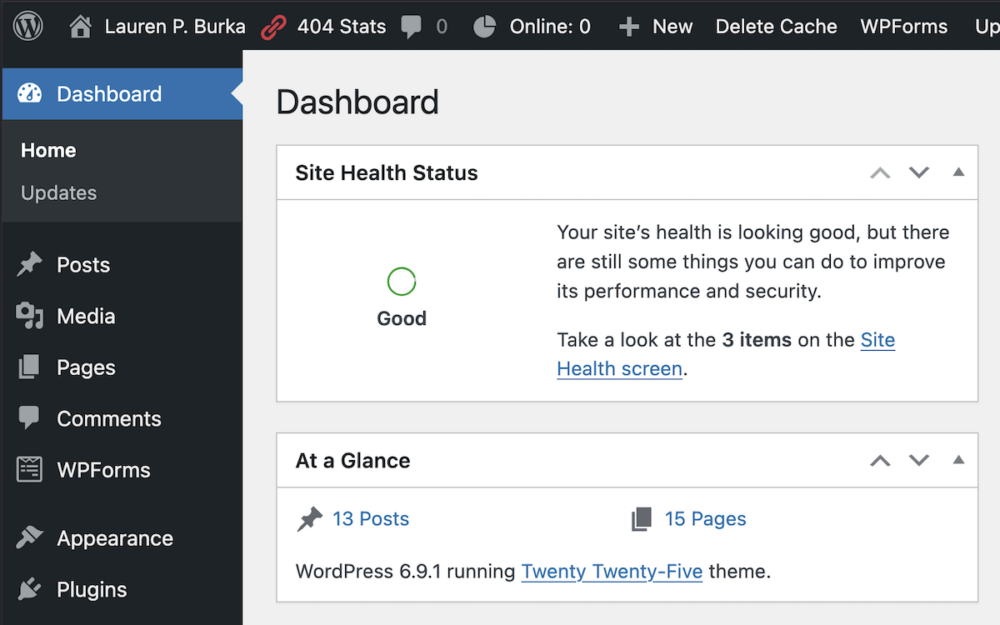
    This site is built in WordPress. This is not an endorsement of WordPress. It’s an endorsement of using the right tool for the job. Often the right tool for the job is one that you already know how to use. If you don’t know how to use any web site software, then the right tool may be one that your friends already know how to use so you can ask them questions informed by having read the manual.

    It just so happens that I’ve been using WordPress for long enough that I don’t remember when I first played with it. I’ve come back to it over the years, even though it keeps changing in ways that are not for the better, and the community is subject to those weird battles that you get when free open source software (FOSS) is involved. On the plus side, the way WordPress wants you to build pages is almost exactly like how all the other services I’m using do. This saves time and frustration.

    From my point of view, the best thing about WordPress is that it is in fact a FOSS platform. That means that lots of people add on to it. Documentation is easy to find, and I can search the web to see if someone else has my problem or, as a last resort, post to r/wordpress begging for help.

    WordPress hosting is a commodity. Pretty much every hosting company out there costs about the same and does things the same way. If I decide I hate Dreamhost, I can bale up my site and move it somewhere else within an hour. This is not an option if you’re using, say, Wix. Nevertheless, my priorities aren’t yours. If you’re comfortable with Wix, use Wix.

    I’m paying Dreamost an additional $20/year for email service because I don’t like or trust Gmail. Also, mail from me@mydomain.com looks, in my opinion, classier than email from me8912@gmail.com, and the difference is worth paying for. For me. I have a mailbox at my domain, and I download and read my mail locally using an IMAP client.

    The last thing I’m going to discuss here is WordPress themes. There are so many themes. How did I choose one?

    I started by internalizing that 70% of all web traffic is from phones. Phone real estate is tiny. Anyone looking at my site on a phone will leave if they have to zoom in to read anything. Multi-column layouts, which were the thing a few years ago, are not suitable for phones. As a bonus, almost anything that looks good on a phone will be readable to a vision impaired person using a screen reader; no meaning is conveyed by the position of an element on the page. I feel that accessibility is the minimum courtesy that I owe someone who stops by my virtual home. Given how most of the web looks these days, I’m in the minority.

    Because I wanted a free theme that I knew would continue to work for years, I decided to limit myself to themes produced by wordpress.org, which creates a new theme every year. After messing with a few of them, I settled on the 2025 theme. It looks simple and is easy to read.

    It is possible to edit a theme to look like anything if you’re willing to code your own CSS. I decided that CSS is a hard limit for me. I don’t want to learn it or maintain it. But if you do, you can make your theme sit up and do tricks.

    How much money am I spending so far? $120/year US. Keep an eye on this number, because it’s going to go up. Am I going to make this money back on book sales? Not yet. But if I don’t spend it, getting those sales is going to be much, much more difficult.

    Next time I’m going to show you what this site looks like behind the magic curtain and how I use this and other sites to build an audience and drive sales. Meanwhile, take a look around and make yourself comfortable in my virtual web home.

  • My Interview with Kaleidoscope Romance

    I was recently interviewed by Kaleidoscope Romance. If you’d like some insight into how, why and what I write, this is a good place to look.

  • So, what’s with all the sex, Lauren?

    My good friend Cecilia Tan says that the two main complaints she sees in reviews of her books are:

    1. Too much sex
    2. Not enough sex

    I’m on a mission to write books such that nobody ever complains about item 2.

    Some of you are probably wondering, “Why? Censorship is a constantly-moving target. Readers seem to like sex in their books, but book distributors, payment processors and Patreon allow it grudgingly, if at all, and it’s about to get worse. Next year you may be in jail in Oklahoma.”

    I blame Aunt Ruth. Under the name of Rebecca York, my aunt has written over 150 romance novels. Ruth once told me that writing is lonely work, difficult and boring work, and that the only way to make progress it is to write what gets you going. As she’s read a couple of my books, I occasionally wonder if she wishes she’d given me different advice.

    I also blame the internet–more precisely, I blame USENET, one of the precursor networks from before the internet was really a thing. Back in the 80’s I joined these completely uncensored exchanges before they were ruined by spammers and commercialization and read the hot stories that college students and employees of defense contractors were writing (That’s where I met Cecilia Tan). I quickly concluded that my ideas were no weirder than anyone else’s, and that I could spell better than at least half of those people. I once read a post on USENET by someone who had been stuck at work babysitting a sick computer and called his girlfriend to tell her he’d be home late. He sat down to read the stories on alt.sex.bondage and found one of mine. Then he called his girlfriend and told her, “I’m coming home right now.” Now that’s feedback I can use.

    While we’re at it, I blame all of those ancient history classes that taught me to think critically about things that were rarely talked about in polite company. Sex and sexual attraction are neither natural nor universal. You’re programmed by what you see around you to find one person attractive and another person not worth a second glance. After a few such classes by thoughtful professors, I started to find the books I was reading a bit frustrating. Why write a book set in a different time and place, on a different planet, and have people with the same relationships that they have during a very narrow slice of time and space out of human history?

    I set out to play around and see what I could write differently. Let me know how I’m doing.

  • Why I don’t use AI

    Let’s get this straight.

    The things that people call AI aren’t AI. They’re not intelligent. Large Language Models are spicy autocomplete. Every time your phone changes “fucking” to “ducking,” you’re getting a reminder that there is no intelligent life here.

    Now that we’ve got that out of the way, I want to assure you that I will not be addressing any of the pressing moral issues surrounding using LLMs in the process of writing books. I’m not going to tell you why you should or shouldn’t use AI. I’m going to tell you why I don’t use it.

    I’m getting old, and I’m not changing my writing process.

    Once upon a time, I knew I wanted to be a writer. The problem was I had horrible handwriting. As a doctor, my dad was legally required to have handwriting that confused pharmacists. Mine was worse. Therefore, I learned to type. My first foray into the art of touch typing was on an assortment of creaky old manual typewriters owned by a summer camp I attended. I was horrible at it, slow and inaccurate with a tendency to drift away from home row. The typing teacher despaired.

    My middle school purchased a dozen instances of the boat anchor-sized, loudly-humming device known as the IBM Selectric. I improved slowly and got indifferent grades in the class. I could type faster in Spanish than I could in English for some reason and used to practice by typing my Spanish homework. But I got going and eventually managed to break twenty or thirty WPM touch-typing. A kindly and somewhat drunk uncle who could hold down no job but working at the pawn shop provided me with an Olivetti, which I used for term papers.

    At that point, due to frustration and running out of correction fluid, I managed to scrape up enough money—largely through accumulated birthday gifts from relatives and summer job earnings—to purchase my first computer: an Apple 2e with the brand-new 80 column card. My typing improved. So did my summer earnings. In those days, if one could type, even slowly and with many corrections, it was possible to earn as much as $8/hr working for a temp agency. I began picking up speed through enforcement by the torture device known as the Dictaphone.

    By the time I needed summer money during college, I could hit one hundred words per minute while using WordStar.

    I think with my fingers, by which I mean that I touch-type. If I need to text more than a word or two, I wait until I come home and sit down at my computer to do it, because I can’t thumb-type. If I’ve finished one book and need to start another one, I take a little time to let ideas cook while knitting a sweater or a pair of socks, then sit down and start typing until the story flows up my fingers to my brain. It may take me a month to write the first thousand words, but only two or three more months to finish the book.

    I once explained to a kind and well-meaning friend that the slow part at the beginning of writing a fantasy novel was coming up with names for everything. Said kind and well-meaning friend offered to take a few example names and run them through Chat-GPT for me, thereby saving me, they said, lots of time. I had to gently, then firmly, then loudly talk them out of trying to help me. Thinking up names for people, places and concepts may be slow, but while I’m doing it, I’m inventing the world. Naming things the way Adam named the animals is how I make a world real to me. If it’s not real to me, it’s not going to be real to the reader (that’s you). Chat-GPT can maybe kind of sort of do this, but it can’t do it the way I do it. You’re reading my book, not Chat-GPT’s. By the way, did you know that to a French speaker, Chat-GPT sounds like “cat, I farted?” (chat, j’ai pété.)

    I have all the time in the world.

    Do the math: if you can write 1,000 words per day, you can write four books a year, easy. This is tricky if you have to hold down a job and take care of kids but not if you don’t.

    LLM-based tools appeal to people who don’t have enough time. Because my health cratered twenty-five years ago and dumped me straight out of the job market and into the wonderful world of “medical retirement,” I don’t lack for time. I don’t even leave the house much, and when I do, I return feeling like I barely escaped with my life. I write, knit and have (checks) over 12,000 hours in Stellaris. And I only need so many sweaters and pairs of socks. Most of my days are spent alternating between playing this or that 4X game, waiting on hold with the doctor’s office and suddenly getting an idea and writing 500 words.

    If I’m not writing, I’m not anyone.

    So why would I use an LLM again?

    Incidentally

    Did you notice that I use em-dashes? For giggles, I pulled up a copy of Wishbone, a book that was first published in 2010. I used fifty-nine em-dashes, though they are rendered as pairs of hyphens, because that’s was what we did then. Did you know that Wishbone is one of the books slurped up and used to train that LLM that’s the subject of a famous lawsuit? If you see an em-dash in one of my books, you can be absolutely secure in the knowledge that it’s not because an LLM wrote it. LLM’s learned about em-dashes from me.


  • About Styrax’s Portrait

    Readers have asked me many times whether shih-aan looked more human or more animal. I’ve always told readers “Shih-aan look as human or animal as makes you happy.”

    Nevertheless, I’ve had it explained to me at length that it’s important to give people who are thinking of reading my books something nice to look at. I’ve worked with artists before with excellent results. But in most cases, I’ve had reference art to hand over. There is no reference art for shih-aan, because they don’t exist.

    I needed an artist to create the reference art. This would not be a small job. And I knew that once I had a picture in hand, shih-aan would always look that way to me.

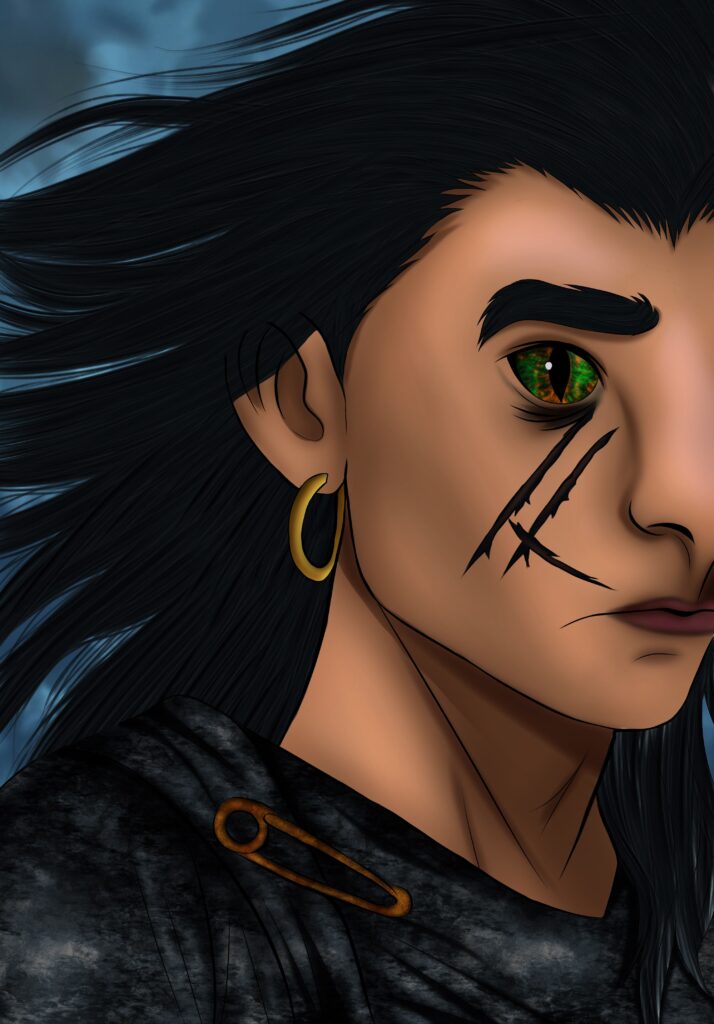
    I spent some time evaluating artist portfolios, emailing artists, and not hearing back from artists before a mutual friend put me in touch with doodlebloom. Doodlebloom did the very difficult job of digging in my head for ideas and rendering them into this beautiful portrait.

    I hope that you, whoever you are, will still feel free to use your imagination when you read my books. But now you know what Styrax looks like to me.

    Non-human character study. Green cat eyes, black hair, medium skin tone, a gold earring and scars on one cheek.
    Styrax the Scarred

    If you like doodlebloom’s work, here’s where to find more information.

    https://bsky.app/profile/doodlebloomm.bsky.social

    https://www.tumblr.com/blog/doodlebloomm

    https://www.instagram.com/doodle.bloom1

  • What’s after Wishbone? Styrax the Scarred

    Did you read Wishbone and Names of My Beloved and wonder what happened next?

    I don’t deal well with finishing books. I do not get a warm feeling of accomplishment. I get post-partum depression. After I finished Names of My Beloved, I spent some time writing outtakes that examined various characters’ lives in an attempt to start the next book. I ran into two problems with this.

    Whenever you write a prequel, some of the events are predetermined, and the story takes on the aspect of a tragedy. Plenty of writers pull this off just fine, but I didn’t feel that I was one of them.

    The other problem is the Age Issue. If the poorly-specified rules for erotica are that there are no minors, I couldn’t write something that happened when a character was growing up.

    So I went forward, and I chose to follow Styrax. What happened to him after he left the scene in Names? At the same time I got some feedback from a beta reader. She asked me a quite reasonable question: how does the other half live? Shieh Yeras, Styrax, and the rest of the named shih-aan characters are educated upper class types. What is it like to be a low-class shih-aan laborer with no rings, an obligate carnivore who has trouble affording meat? I could write that book and welcome readers to explore more of Feras-aan.

    The problem was that Styrax is, well, speak as I find, a vanilla. It’s even built into his name.

    Styrax is the name of a genus of shrubs and small trees from which humans have harvested aromatic resin since time immemorial, just like frankincense and myrrh. If you’re looking to buy the solid resin or the sticky essential oil, you should shop for benzoin, which is the proper name for the stuff. You can buy a small container of benzoin resin for under $10 on etsy. You’ve undoubtedly smelled benzoin before as it is a very common bass note in quality incense. Its fragrance is dreamy with prominent vanilla notes. Like frankincense and myrrh, which were special enough for gifts for an infant god, it has been assigned therapeutic properties.

    If you read the Thousand Night and One Night, you’ll recognize benzoin immediately:

    [I]t was a lady of tall figure, some five feet high; a model of beauty and loveliness, brilliance and symmetry and perfect grace. Her forehead was flower white; her cheeks like the anemone ruddy bright; her eyes were those of the wild heifer or the gazelle, with eyebrows like the crescent moon which ends Sha’aban and begins Ramazan; her mouth was the ring of Sulayman, her lips coral red, and her teeth like a line of strung pearls or of camomile petals. Her throat recalled the antelope’s, and her breasts, like two pomegranates of even size, stood at bay as it were, her body rose and fell in waves below her dress like the rolls of a piece of brocade, and her navel would hold an ounce of benzoin ointment. –Arabian Nights, Vol. 1 (Chap. 4) Burton trans.

    And because it’s a trope, you’ll see it over and over, either because it recurred in the original text the way an oral formulaic recurs, or because Burton was lazy (and a humongous perv; he also translated the Kama Sutra for the titillation of the British Empire).

    Both Names and Styrax contain some homage to the Thousand Nights and One Night, because it’s the fount of all stories.

    But if Styrax was a vanilla, I’d already written him asking Wishbone not to be nice to him. At all. Perhaps there would be an opportunity to turn him kinky if he met the right person. That’s what I set out to write. And after four years and 250,000 words, I believe I succeeded.

    Styrax the Scarred is now being serialized on my Patreon.

  • Fraternity Alpha is (almost) live

    My new project, Fraternity Alpha, has the first chapter live and free on the new platform Theoreads.

    What’s it about? Here:

    Amy is a woman in her thirties, working in human resources and dodging attempts by family members to set her up on blind dates. But she dreams of being initiated into masculinity at the hands of a ruthless, paddle-wielding frat brother.
    After meeting an old acquaintance at a disappointing kink convention, Amy goes home with the business card of a professional dominant who can help her realize some of her fantasies. All it will cost her is money.
    There’s only one catch.
    The dominant is a gay man, and sex is not on the menu.
    But Amy will take what she can get while she dreams of so much more.
    Fraternity Alpha is a high-kink, high-spice romance about gender identity beyond the binary.

  • Rock and Roll Heresy

    Rock music is heresy. It has a unique ability to slide ideas into one’s soul through the ears. Coming to you over FM or over the internet, rock is a worship service for the god Dionysos; the guitar is one aspect of the thyrsos, his phallic wand that gives milk and honey and sustains his worshippers in the wilderness. Unconstrained by mortal notions of proper behavior, the god changes genders onstage and in our heads. Ecstatic music is a gift from the spirit of drunken frenzy to humanity—a compensation for the inescapable fact that we will all die some day.

    Rock music changes the world. When Pat Benatar’s song “Hell is for Children” hit the airwaves in 1980, thousands of suburban kids looked up and realized they were not the only ones ordered to lie to grandma and say they fell off the swing. And they learned that what was happening to them was not OK and never would be.

    If you grew up thinking that “gay” was nothing but a terrible word to call other children, rock educated you otherwise.

    I was ten when “Renegade” by Styx charted. I remember hearing that song and feeling…something when JY’s guitar wailed and crunched on the bridge and Tommy Shaw screamed at the top of his lungs that he didn’t want to die on the gallows. I didn’t have a word for that feeling until later. But I saved my allowance and spent it at the record store in the mall.

    The pre-Shaw Styx album Cornerstone had a song entitled “First Time For Love,” which was the slow-dance song in middle school. I remember reading the tiny lyrics in the fold-out album cover. And there, right below that song—in the tiniest font ever—were the words, “For Paul.”

    I kept reading, over and over, the words that meant that someone loved a man named Paul, and that—most importantly—everyone else in the band was OK with this.

    If you’re paying attention to the lyrics of Cyndi Lauper’s song “She Bop,” you know what it’s about. But it takes a certain level of 1980’s cultural literacy to place Blue Boy Magazine. Ms. Lauper was, apparently, not reading a soft core gay rag for the articles.

    And then there was “The Belle of St. Marks,” which Prince wrote for his good friend, the percussionist Sheila E. Prince never said what the song is about. We’re left to guess why Belle uses masculine pronouns. Why is he wearing his dad’s clothes? Doesn’t he have his own? Unless all of his clothes are dresses. No wonder he cries. Despite—or because of—his tears, the Belle is a hot man, and Sheila will die if she can’t have him. Doesn’t she sound like she’s singing with her hands down her pants at the end? Well done, madam.

    Joan Jett covered a male vocalist to sing us a honey-dripping song, “Crimson and Clover,” about her love for a woman. And, by the way, she’s not ashamed to say that love is pain.

    Fast-forward to 1998. Brian Molko of Placebo jumped off a London building in the video for “Pure Morning” and did not fall. The song has music-of-the-spheres guitar riffs and lyrics that would make Molko nauseous later; he’d have re-written them if he knew that the song would be Placebo’s highest-charting hit. “Pure Morning” might not have got quite so much attention if someone hadn’t decided to slap a self-harm warning on the video. Controversy ensued. Once more, thousands of isolated suburban kids took notice, this time of the androgynous rock star with the bare shoulders. Some of them went out, bought black nail polish and painted their toenails as the first tiny step towards figuring out who they were.

    For a while, music was out of the closet. Now it’s feeling less and less safe to celebrate queerness with the joy that love and pleasure deserve. But pay close attention to those lyrics. Dionysos will be looking out from between the lines, laughing and changing genders without warning.

    See you on the other side.

    * * *

  • New Project: Fraternity Alpha

    Back in December while I was trying to avoid reality, I started writing a project that had been in the back of my head for a while.

    I write mostly Fantasy and SciFi erotica. I know there are readers out there who are into this, because I used to sell them books. I’m sure I’ll find these people again. But fantasy erotica tends to confuse erotica and romance readers who are not familiar with fantasy tropes, angst and tragic backstories, not to mention characters who don’t have driver’s licenses and can’t prove they are over eighteen. It confuses fantasy readers…

    Actually, that’s a good question. Why does fantasy erotica confuse fantasy readers? I mean, have you read any fantasy lately? Magic systems are really in. Most fantasy readers are used to reading books where the magic system is the main character, where describing it takes hundreds of pages. If you show them a book where much of the characterization happens through sex, they wander off to read another book about how red gems have different magical properties than blue gems.

    Not that there’s anything wrong with that.

    My point here is that my writing feels very niche. The correct way for me to deal with this is to meet readers closer to where they live. I decided to write something less niche, put it up on a new platform that I’ll mention in a bit, and see if people like it.

    As I said, I had a huge incentive to focus on something other than the real world. I wrote a 100k word novel in five weeks. My left wrist is sore, but it was worth it. This book really wanted to be written.

    It’s called:

    Fraternity Alpha: A Genderqueer Love Story

    I set some constraints on the project:

    • Real world. I was originally going to locate it in a generic city, but I was unable to resist making fun of Milton, MA. I love Boston, but the in-jokes are funny for a reason. I live in Cambridge; NIMBY’s can sit and spin.
    • Traditional romance plot structure, because plotting a novel is one of my weak points. Adopting the structure helped me organize all the hot sex and messy emotions. That meant:
    • A traditional Happily Ever After.
    • Female protagonist. Yes, this was a challenge for me. This meant:
    • Most of the characters are queer.
    • The queer people have real world queer joys and queer problems.
    • Their problems are human problems, human-sized with human resolutions.
    • All characters are over 21 and have ID to prove it.
    • The sex is the hot, kinky sort that gets me thoughtful reviews from people who say things like, “Her books are gutsy, emotional, well written, unusual, brave and just plain lovely.” The sex the characters are having is the sex that those characters would have. The sex tells you more about the characters than where they live, what they do for fun with their clothes on, whose kids they are, what they wear or what they eat.

    There are some broader themes that people who have read my other fiction will recognize.

    There’s a trope in romantasy where the MMC automatically understands what the FMC needs, because shadowdaddy with mind-reading powers. I’ve rarely found this trope fulfilling, though I couldn’t tell you if that was a problem I have with the trope or a problem I have with people who have read the trope and think they can pull it off in real life, with disastrous results.

    What is far sexier to me–and far more worth writing–is characters who actively discuss what they want and how they can make each other happy. Relationships can come about through random acts of the universe. But they require active care and tending by all participants.

    Someone very close to me once said that I have a trust fetish. He has a point.

    The seed that sprouted this novel was planted in about 1992. I had to fill out financial aid forms for graduate school, and I was overwhelmed. By coincidence, I attended a house party where one of the hosts was a tax accountant and a rock singer. She offered to help me fill out the paperwork in exchange for some jewelry I was making back then. I visited her at her office at H&R Block, sat down and listened to her tell me that tax accounting is a fantastic job for creative people, because talking to people and solving their problems is part of the job, unlike waiting tables. She explained about getting laid off every year and rehired. She helped me fill out the paperwork, and I got a financial aid package that enabled me to get a CS degree.

    I didn’t find out until later that she was a professional dominant.

    So what’s it about?

    Amy is a woman in her thirties, working in human resources and dodging attempts by family members to set her up on blind dates. But she dreams of being initiated into masculinity at the hands of a ruthless, paddle-wielding frat brother.

    After meeting an old acquaintance at a disappointing kink convention, Amy goes home with the business card of a professional dominant who can help her realize some of her fantasies. All it will cost her is money.

    There’s only one catch.

    The dominant is a gay man, and sex is not on the menu.

    But Amy will take what she can get while she dreams of so much more.

    Fraternity Alpha is a high-kink, high-spice romance about gender identity beyond the binary.

    A New Web Platform

    There is a new way to read erotica and romance coming soon: TheoReads.com.

    We’ve all watched access to erotica–especially queer erotica–be curtailed by major platforms and payment processors. If we want to see ourselves in books, we need more ways for authors and readers to connect.

    Theo is a web based platform that will allow you to pick and chose among your favorite tropes and kinks so you can find and buy those stories that were written for you. You get something hot, and the authors get paid.

    Right now Theo is still starting up. When it’s a bit more solid, you’ll be able to purchase access to Fraternity Alpha there. You’ll also be able to read Wishbone and some stories of mine that have been hard to find for years.

    Stories are only exclusive to Theo for six months. That means that six months after Fraternity Alpha is available on Theo, you’ll be able to get an ebook or read it on my Patreon.

    I’ll be sure to post as soon as I have news about Theo.