I have an aunt who, gods bless her, has written over 140 romance novels. I have a memory dating to some time in the 1980’s of her holding up a genuine paperback copy of one of her romances. “I can’t believe this cover,” she said, pointing out the gray-haired man groping the heroine who, according to romance traditions, was supposed to be about twenty-two. “He looks like a Geritol ad.”
Readers have funny ideas about cover art. For instance, they think that the author chooses it. In reality this never happens. The cover art in traditionally published novels is chosen by an art department, possibly but not necessarily in consultation with the editor and the author. The art is supposed to draw the eye of a potential purchaser and make them touch the physical book and, hopefully, buy it, bring it home, read it, review it, and convince their friends to read it too. The final book cover has always been constrained by artists, models, ideas about colors and assorted semiotics, all permuted through the hurry-up-and-wait publication schedule. If the characters in the cover look like the author thinks the characters look, it’s probably a happy coincidence.
Back in the day you could tell a book was science fiction because it had:
- An aerodynamic-looking space ship. The ship had to be aerodynamic-looking even though it would never enter the atmosphere.
- A babe breasting boobily in a chainmail bikini.
These elements were required on all sci-fi covers even if the actual book contained no boobily breasting babes or space ships. If the reader is disappointed by the lack of boobs and/or ships, it doesn’t matter, because they’ve already paid.
At some point this changed. I credit cover artist Michael Whelan. If you don’t know who he is, go look up his work.
The best piece of cover art I ever got was probably the cover for my first chapbook, Mate, published in 1992. The artist worked for free. I fed her an idea, and she ran with it. I got one phone call from her. She asked me, “Mind if I have some fun with the horse?” I told her to go for it (if people are doing things for you for free, you don’t feel like you can ask for much). She sketched the chess knight and the riding whip, and bolstered the details with the press-on stuff made by Letraset that everyone used to use. You can check out the attitude on that chess knight’s face on my web site. I have the knight and whip as a tattoo on my left arm. I remember the cover artist’s eyes opening very, very wide when I showed it to her. “Yes,” I said. “I will have your art on my body when I’m 90 years old and everything sags.”
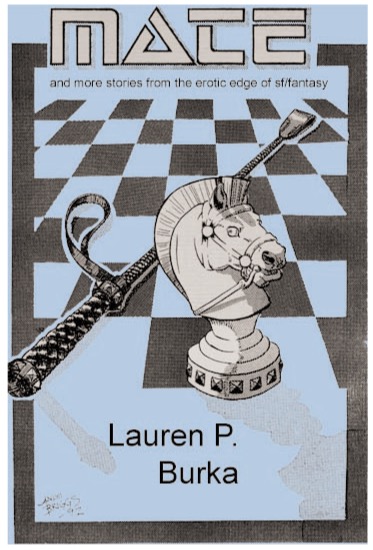
Nota Bene: The artist who rendered the tattoo was, in fact, an artist, a highly-regarded, well-known one. She made some notable contributions, such as flipping the art left-to-right so that the horse would be facing front. This is the kind of detail that an artist notices, and why she was worth every penny.
For reasons that I’m about to get into, I’m unlikely to have cover art that I want on my body ever again. I’ll be lucky if I ever get cover art that I can look at without feeling embarrassed.
The reason for that is that the industry has decided that the way around the expense and bother of using human cover artists is to use AI generation. Let’s be clear on what this means.
There is no such thing as artificial intelligence. When I was in grad school in the 90’s, the word was that AI had been just around the corner for so many decades that researchers were advised to take whatever they had and call it AI or lose their funding. That’s an ongoing process.
Now we have large language models built out of surplus graphics cards sold off by failed crypto firms, using truly astonishing amounts of water and energy, sucking down all the Geritol ads, rocket ships, moths (for some reason moths are really in for book covers right now) and breastily boobing bikini babes that have ever been used to illustrate a cover and spit out the kind of uncanny valley results that will immediately provide a source of endless amusement to readers of r/fantasyromance or other such online gatherings. Artists will point out all of the obvious AI art tells, the six fingered hands and sunken eyes, and readers will immediately conclude that the authors who use AI art for their covers do not care about their readers, that the text of the books are probably AI generated and not worth anyone’s time or effort to read. They will think the the author chose the art, because readers always think that. The discussions will be hilarious, unless it’s your book, in which case you’ll read it and burst into tears.
How do I know this? It’s happening right now. Go look.
Let’s talk about skuomorphs. You know what they are. Just like early iPhones used a yellow lined facsimile of a notepad because users all (used to) know what a note pad looks like and how it’s used, just like early ceramic artists made jugs in the same shape as a hollowed out gourd because everyone knew how to use one of those, book covers these days are cast in the outdated form of something that used to be appropriate but now makes no sense.
If a book isn’t sitting on a shelf, if it’s read and consumed solely on a palm-sized device where the details are too small to see, why does everyone insist on having a human figure straight out of the uncanny valley on the cover? Who does this benefit? Certainly not visually impaired readers who are using text to speech or screen readers to navigate your books. And they’re the lucky ones, because they don’t have to see the figures with uneven eyes or cut-off fingers.
I’d much rather have a book cover with a readable font that says what’s inside. I’ve heard that readers have come to expect that the more discreet the cover, the hotter the contents.
But this is just about me. If you use an AI generated cover, I will not judge. Neither will I read.