I was recently interviewed by Kaleidoscope Romance. If you’d like some insight into how, why and what I write, this is a good place to look.
Author: LaurenPBurka
-
So, what’s with all the sex, Lauren?
My good friend Cecilia Tan says that the two main complaints she sees in reviews of her books are:
- Too much sex
- Not enough sex
I’m on a mission to write books such that nobody ever complains about item 2.
Some of you are probably wondering, “Why? Censorship is a constantly-moving target. Readers seem to like sex in their books, but book distributors, payment processors and Patreon allow it grudgingly, if at all, and it’s about to get worse. Next year you may be in jail in Oklahoma.”
I blame Aunt Ruth. Under the name of Rebecca York, my aunt has written over 150 romance novels. Ruth once told me that writing is lonely work, difficult and boring work, and that the only way to make progress it is to write what gets you going. As she’s read a couple of my books, I occasionally wonder if she wishes she’d given me different advice.
I also blame the internet–more precisely, I blame USENET, one of the precursor networks from before the internet was really a thing. Back in the 80’s I joined these completely uncensored exchanges before they were ruined by spammers and commercialization and read the hot stories that college students and employees of defense contractors were writing (That’s where I met Cecilia Tan). I quickly concluded that my ideas were no weirder than anyone else’s, and that I could spell better than at least half of those people. I once read a post on USENET by someone who had been stuck at work babysitting a sick computer and called his girlfriend to tell her he’d be home late. He sat down to read the stories on alt.sex.bondage and found one of mine. Then he called his girlfriend and told her, “I’m coming home right now.” Now that’s feedback I can use.
While we’re at it, I blame all of those ancient history classes that taught me to think critically about things that were rarely talked about in polite company. Sex and sexual attraction are neither natural nor universal. You’re programmed by what you see around you to find one person attractive and another person not worth a second glance. After a few such classes by thoughtful professors, I started to find the books I was reading a bit frustrating. Why write a book set in a different time and place, on a different planet, and have people with the same relationships that they have during a very narrow slice of time and space out of human history?
I set out to play around and see what I could write differently. Let me know how I’m doing.
-
Why I don’t use AI
Let’s get this straight.
The things that people call AI aren’t AI. They’re not intelligent. Large Language Models are spicy autocomplete. Every time your phone changes “fucking” to “ducking,” you’re getting a reminder that there is no intelligent life here.
Now that we’ve got that out of the way, I want to assure you that I will not be addressing any of the pressing moral issues surrounding using LLMs in the process of writing books. I’m not going to tell you why you should or shouldn’t use AI. I’m going to tell you why I don’t use it.
I’m getting old, and I’m not changing my writing process.
Once upon a time, I knew I wanted to be a writer. The problem was I had horrible handwriting. As a doctor, my dad was legally required to have handwriting that confused pharmacists. Mine was worse. Therefore, I learned to type. My first foray into the art of touch typing was on an assortment of creaky old manual typewriters owned by a summer camp I attended. I was horrible at it, slow and inaccurate with a tendency to drift away from home row. The typing teacher despaired.
My middle school purchased a dozen instances of the boat anchor-sized, loudly-humming device known as the IBM Selectric. I improved slowly and got indifferent grades in the class. I could type faster in Spanish than I could in English for some reason and used to practice by typing my Spanish homework. But I got going and eventually managed to break twenty or thirty WPM touch-typing. A kindly and somewhat drunk uncle who could hold down no job but working at the pawn shop provided me with an Olivetti, which I used for term papers.
At that point, due to frustration and running out of correction fluid, I managed to scrape up enough money—largely through accumulated birthday gifts from relatives and summer job earnings—to purchase my first computer: an Apple 2e with the brand-new 80 column card. My typing improved. So did my summer earnings. In those days, if one could type, even slowly and with many corrections, it was possible to earn as much as $8/hr working for a temp agency. I began picking up speed through enforcement by the torture device known as the Dictaphone.
By the time I needed summer money during college, I could hit one hundred words per minute while using WordStar.
I think with my fingers, by which I mean that I touch-type. If I need to text more than a word or two, I wait until I come home and sit down at my computer to do it, because I can’t thumb-type. If I’ve finished one book and need to start another one, I take a little time to let ideas cook while knitting a sweater or a pair of socks, then sit down and start typing until the story flows up my fingers to my brain. It may take me a month to write the first thousand words, but only two or three more months to finish the book.
I once explained to a kind and well-meaning friend that the slow part at the beginning of writing a fantasy novel was coming up with names for everything. Said kind and well-meaning friend offered to take a few example names and run them through Chat-GPT for me, thereby saving me, they said, lots of time. I had to gently, then firmly, then loudly talk them out of trying to help me. Thinking up names for people, places and concepts may be slow, but while I’m doing it, I’m inventing the world. Naming things the way Adam named the animals is how I make a world real to me. If it’s not real to me, it’s not going to be real to the reader (that’s you). Chat-GPT can maybe kind of sort of do this, but it can’t do it the way I do it. You’re reading my book, not Chat-GPT’s. By the way, did you know that to a French speaker, Chat-GPT sounds like “cat, I farted?” (chat, j’ai pété.)
I have all the time in the world.
Do the math: if you can write 1,000 words per day, you can write four books a year, easy. This is tricky if you have to hold down a job and take care of kids but not if you don’t.
LLM-based tools appeal to people who don’t have enough time. Because my health cratered twenty-five years ago and dumped me straight out of the job market and into the wonderful world of “medical retirement,” I don’t lack for time. I don’t even leave the house much, and when I do, I return feeling like I barely escaped with my life. I write, knit and have (checks) over 12,000 hours in Stellaris. And I only need so many sweaters and pairs of socks. Most of my days are spent alternating between playing this or that 4X game, waiting on hold with the doctor’s office and suddenly getting an idea and writing 500 words.
If I’m not writing, I’m not anyone.
So why would I use an LLM again?
Incidentally
Did you notice that I use em-dashes? For giggles, I pulled up a copy of Wishbone, a book that was first published in 2010. I used fifty-nine em-dashes, though they are rendered as pairs of hyphens, because that’s was what we did then. Did you know that Wishbone is one of the books slurped up and used to train that LLM that’s the subject of a famous lawsuit? If you see an em-dash in one of my books, you can be absolutely secure in the knowledge that it’s not because an LLM wrote it. LLM’s learned about em-dashes from me.
-
Samhain Short Story on Theoreads.com
I have a new short story up on Theoreads.com.
The Doors of the Year is a paranormal shifter story about sexy things that go bump in the night around Halloween.
-
About Styrax’s Portrait
Readers have asked me many times whether shih-aan looked more human or more animal. I’ve always told readers “Shih-aan look as human or animal as makes you happy.”
Nevertheless, I’ve had it explained to me at length that it’s important to give people who are thinking of reading my books something nice to look at. I’ve worked with artists before with excellent results. But in most cases, I’ve had reference art to hand over. There is no reference art for shih-aan, because they don’t exist.
I needed an artist to create the reference art. This would not be a small job. And I knew that once I had a picture in hand, shih-aan would always look that way to me.
I spent some time evaluating artist portfolios, emailing artists, and not hearing back from artists before a mutual friend put me in touch with doodlebloom. Doodlebloom did the very difficult job of digging in my head for ideas and rendering them into this beautiful portrait.
I hope that you, whoever you are, will still feel free to use your imagination when you read my books. But now you know what Styrax looks like to me.
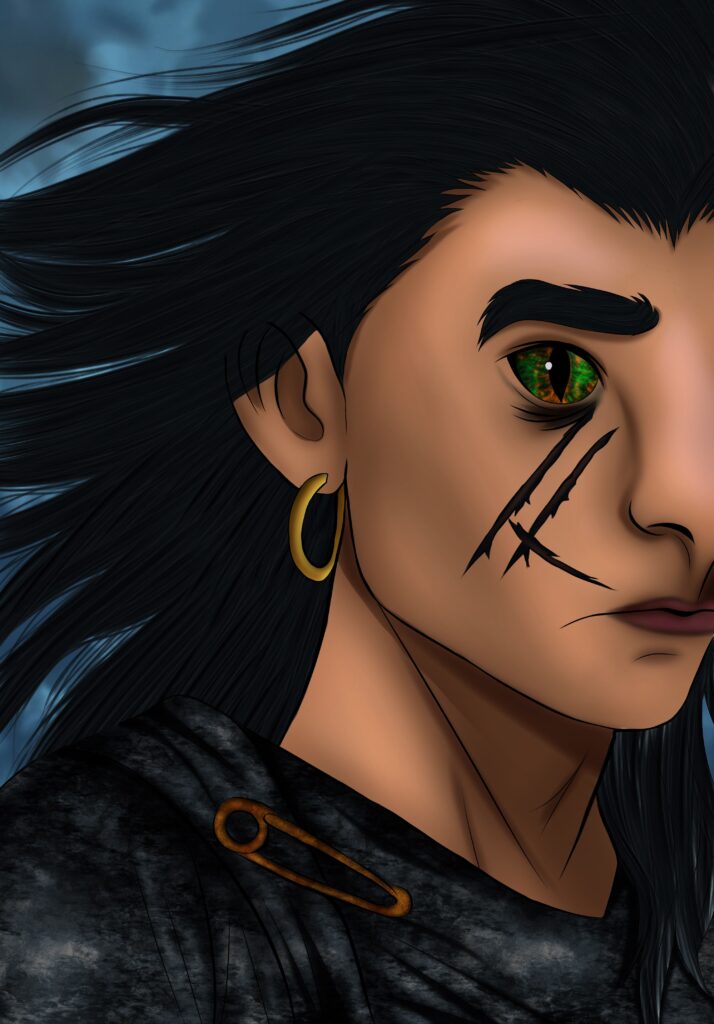
Styrax the Scarred If you like doodlebloom’s work, here’s where to find more information.
https://bsky.app/profile/doodlebloomm.bsky.social
-
What’s after Wishbone? Styrax the Scarred
Did you read Wishbone and Names of My Beloved and wonder what happened next?
I don’t deal well with finishing books. I do not get a warm feeling of accomplishment. I get post-partum depression. After I finished Names of My Beloved, I spent some time writing outtakes that examined various characters’ lives in an attempt to start the next book. I ran into two problems with this.
Whenever you write a prequel, some of the events are predetermined, and the story takes on the aspect of a tragedy. Plenty of writers pull this off just fine, but I didn’t feel that I was one of them.
The other problem is the Age Issue. If the poorly-specified rules for erotica are that there are no minors, I couldn’t write something that happened when a character was growing up.
So I went forward, and I chose to follow Styrax. What happened to him after he left the scene in Names? At the same time I got some feedback from a beta reader. She asked me a quite reasonable question: how does the other half live? Shieh Yeras, Styrax, and the rest of the named shih-aan characters are educated upper class types. What is it like to be a low-class shih-aan laborer with no rings, an obligate carnivore who has trouble affording meat? I could write that book and welcome readers to explore more of Feras-aan.
The problem was that Styrax is, well, speak as I find, a vanilla. It’s even built into his name.
Styrax is the name of a genus of shrubs and small trees from which humans have harvested aromatic resin since time immemorial, just like frankincense and myrrh. If you’re looking to buy the solid resin or the sticky essential oil, you should shop for benzoin, which is the proper name for the stuff. You can buy a small container of benzoin resin for under $10 on etsy. You’ve undoubtedly smelled benzoin before as it is a very common bass note in quality incense. Its fragrance is dreamy with prominent vanilla notes. Like frankincense and myrrh, which were special enough for gifts for an infant god, it has been assigned therapeutic properties.
If you read the Thousand Night and One Night, you’ll recognize benzoin immediately:
[I]t was a lady of tall figure, some five feet high; a model of beauty and loveliness, brilliance and symmetry and perfect grace. Her forehead was flower white; her cheeks like the anemone ruddy bright; her eyes were those of the wild heifer or the gazelle, with eyebrows like the crescent moon which ends Sha’aban and begins Ramazan; her mouth was the ring of Sulayman, her lips coral red, and her teeth like a line of strung pearls or of camomile petals. Her throat recalled the antelope’s, and her breasts, like two pomegranates of even size, stood at bay as it were, her body rose and fell in waves below her dress like the rolls of a piece of brocade, and her navel would hold an ounce of benzoin ointment. –Arabian Nights, Vol. 1 (Chap. 4) Burton trans.
And because it’s a trope, you’ll see it over and over, either because it recurred in the original text the way an oral formulaic recurs, or because Burton was lazy (and a humongous perv; he also translated the Kama Sutra for the titillation of the British Empire).
Both Names and Styrax contain some homage to the Thousand Nights and One Night, because it’s the fount of all stories.
But if Styrax was a vanilla, I’d already written him asking Wishbone not to be nice to him. At all. Perhaps there would be an opportunity to turn him kinky if he met the right person. That’s what I set out to write. And after four years and 250,000 words, I believe I succeeded.
-
Fraternity Alpha is (almost) live
My new project, Fraternity Alpha, has the first chapter live and free on the new platform Theoreads.
What’s it about? Here:
Amy is a woman in her thirties, working in human resources and dodging attempts by family members to set her up on blind dates. But she dreams of being initiated into masculinity at the hands of a ruthless, paddle-wielding frat brother.
After meeting an old acquaintance at a disappointing kink convention, Amy goes home with the business card of a professional dominant who can help her realize some of her fantasies. All it will cost her is money.
There’s only one catch.
The dominant is a gay man, and sex is not on the menu.
But Amy will take what she can get while she dreams of so much more.
Fraternity Alpha is a high-kink, high-spice romance about gender identity beyond the binary. -
Rock and Roll Heresy
Rock music is heresy. It has a unique ability to slide ideas into one’s soul through the ears. Coming to you over FM or over the internet, rock is a worship service for the god Dionysos; the guitar is one aspect of the thyrsos, his phallic wand that gives milk and honey and sustains his worshippers in the wilderness. Unconstrained by mortal notions of proper behavior, the god changes genders onstage and in our heads. Ecstatic music is a gift from the spirit of drunken frenzy to humanity—a compensation for the inescapable fact that we will all die some day.
Rock music changes the world. When Pat Benatar’s song “Hell is for Children” hit the airwaves in 1980, thousands of suburban kids looked up and realized they were not the only ones ordered to lie to grandma and say they fell off the swing. And they learned that what was happening to them was not OK and never would be.
If you grew up thinking that “gay” was nothing but a terrible word to call other children, rock educated you otherwise.
I was ten when “Renegade” by Styx charted. I remember hearing that song and feeling…something when JY’s guitar wailed and crunched on the bridge and Tommy Shaw screamed at the top of his lungs that he didn’t want to die on the gallows. I didn’t have a word for that feeling until later. But I saved my allowance and spent it at the record store in the mall.
The pre-Shaw Styx album Cornerstone had a song entitled “First Time For Love,” which was the slow-dance song in middle school. I remember reading the tiny lyrics in the fold-out album cover. And there, right below that song—in the tiniest font ever—were the words, “For Paul.”
I kept reading, over and over, the words that meant that someone loved a man named Paul, and that—most importantly—everyone else in the band was OK with this.
If you’re paying attention to the lyrics of Cyndi Lauper’s song “She Bop,” you know what it’s about. But it takes a certain level of 1980’s cultural literacy to place Blue Boy Magazine. Ms. Lauper was, apparently, not reading a soft core gay rag for the articles.
And then there was “The Belle of St. Marks,” which Prince wrote for his good friend, the percussionist Sheila E. Prince never said what the song is about. We’re left to guess why Belle uses masculine pronouns. Why is he wearing his dad’s clothes? Doesn’t he have his own? Unless all of his clothes are dresses. No wonder he cries. Despite—or because of—his tears, the Belle is a hot man, and Sheila will die if she can’t have him. Doesn’t she sound like she’s singing with her hands down her pants at the end? Well done, madam.
Joan Jett covered a male vocalist to sing us a honey-dripping song, “Crimson and Clover,” about her love for a woman. And, by the way, she’s not ashamed to say that love is pain.
Fast-forward to 1998. Brian Molko of Placebo jumped off a London building in the video for “Pure Morning” and did not fall. The song has music-of-the-spheres guitar riffs and lyrics that would make Molko nauseous later; he’d have re-written them if he knew that the song would be Placebo’s highest-charting hit. “Pure Morning” might not have got quite so much attention if someone hadn’t decided to slap a self-harm warning on the video. Controversy ensued. Once more, thousands of isolated suburban kids took notice, this time of the androgynous rock star with the bare shoulders. Some of them went out, bought black nail polish and painted their toenails as the first tiny step towards figuring out who they were.
For a while, music was out of the closet. Now it’s feeling less and less safe to celebrate queerness with the joy that love and pleasure deserve. But pay close attention to those lyrics. Dionysos will be looking out from between the lines, laughing and changing genders without warning.
See you on the other side.
* * *
-
New Project: Fraternity Alpha
Back in December while I was trying to avoid reality, I started writing a project that had been in the back of my head for a while.
I write mostly Fantasy and SciFi erotica. I know there are readers out there who are into this, because I used to sell them books. I’m sure I’ll find these people again. But fantasy erotica tends to confuse erotica and romance readers who are not familiar with fantasy tropes, angst and tragic backstories, not to mention characters who don’t have driver’s licenses and can’t prove they are over eighteen. It confuses fantasy readers…
Actually, that’s a good question. Why does fantasy erotica confuse fantasy readers? I mean, have you read any fantasy lately? Magic systems are really in. Most fantasy readers are used to reading books where the magic system is the main character, where describing it takes hundreds of pages. If you show them a book where much of the characterization happens through sex, they wander off to read another book about how red gems have different magical properties than blue gems.
Not that there’s anything wrong with that.
My point here is that my writing feels very niche. The correct way for me to deal with this is to meet readers closer to where they live. I decided to write something less niche, put it up on a new platform that I’ll mention in a bit, and see if people like it.
As I said, I had a huge incentive to focus on something other than the real world. I wrote a 100k word novel in five weeks. My left wrist is sore, but it was worth it. This book really wanted to be written.
It’s called:
Fraternity Alpha: A Genderqueer Love Story
I set some constraints on the project:
- Real world. I was originally going to locate it in a generic city, but I was unable to resist making fun of Milton, MA. I love Boston, but the in-jokes are funny for a reason. I live in Cambridge; NIMBY’s can sit and spin.
- Traditional romance plot structure, because plotting a novel is one of my weak points. Adopting the structure helped me organize all the hot sex and messy emotions. That meant:
- A traditional Happily Ever After.
- Female protagonist. Yes, this was a challenge for me. This meant:
- Most of the characters are queer.
- The queer people have real world queer joys and queer problems.
- Their problems are human problems, human-sized with human resolutions.
- All characters are over 21 and have ID to prove it.
- The sex is the hot, kinky sort that gets me thoughtful reviews from people who say things like, “Her books are gutsy, emotional, well written, unusual, brave and just plain lovely.” The sex the characters are having is the sex that those characters would have. The sex tells you more about the characters than where they live, what they do for fun with their clothes on, whose kids they are, what they wear or what they eat.
There are some broader themes that people who have read my other fiction will recognize.
There’s a trope in romantasy where the MMC automatically understands what the FMC needs, because shadowdaddy with mind-reading powers. I’ve rarely found this trope fulfilling, though I couldn’t tell you if that was a problem I have with the trope or a problem I have with people who have read the trope and think they can pull it off in real life, with disastrous results.
What is far sexier to me–and far more worth writing–is characters who actively discuss what they want and how they can make each other happy. Relationships can come about through random acts of the universe. But they require active care and tending by all participants.
Someone very close to me once said that I have a trust fetish. He has a point.
The seed that sprouted this novel was planted in about 1992. I had to fill out financial aid forms for graduate school, and I was overwhelmed. By coincidence, I attended a house party where one of the hosts was a tax accountant and a rock singer. She offered to help me fill out the paperwork in exchange for some jewelry I was making back then. I visited her at her office at H&R Block, sat down and listened to her tell me that tax accounting is a fantastic job for creative people, because talking to people and solving their problems is part of the job, unlike waiting tables. She explained about getting laid off every year and rehired. She helped me fill out the paperwork, and I got a financial aid package that enabled me to get a CS degree.
I didn’t find out until later that she was a professional dominant.
So what’s it about?
Amy is a woman in her thirties, working in human resources and dodging attempts by family members to set her up on blind dates. But she dreams of being initiated into masculinity at the hands of a ruthless, paddle-wielding frat brother.
After meeting an old acquaintance at a disappointing kink convention, Amy goes home with the business card of a professional dominant who can help her realize some of her fantasies. All it will cost her is money.
There’s only one catch.
The dominant is a gay man, and sex is not on the menu.
But Amy will take what she can get while she dreams of so much more.
Fraternity Alpha is a high-kink, high-spice romance about gender identity beyond the binary.
A New Web Platform
There is a new way to read erotica and romance coming soon: TheoReads.com.
We’ve all watched access to erotica–especially queer erotica–be curtailed by major platforms and payment processors. If we want to see ourselves in books, we need more ways for authors and readers to connect.
Theo is a web based platform that will allow you to pick and chose among your favorite tropes and kinks so you can find and buy those stories that were written for you. You get something hot, and the authors get paid.
Right now Theo is still starting up. When it’s a bit more solid, you’ll be able to purchase access to Fraternity Alpha there. You’ll also be able to read Wishbone and some stories of mine that have been hard to find for years.
Stories are only exclusive to Theo for six months. That means that six months after Fraternity Alpha is available on Theo, you’ll be able to get an ebook or read it on my Patreon.
I’ll be sure to post as soon as I have news about Theo.
-
Cover art: Why are we doing this to ourselves (again?)
I have an aunt who, gods bless her, has written over 140 romance novels. I have a memory dating to some time in the 1980’s of her holding up a genuine paperback copy of one of her romances. “I can’t believe this cover,” she said, pointing out the gray-haired man groping the heroine who, according to romance traditions, was supposed to be about twenty-two. “He looks like a Geritol ad.”
Readers have funny ideas about cover art. For instance, they think that the author chooses it. In reality this never happens. The cover art in traditionally published novels is chosen by an art department, possibly but not necessarily in consultation with the editor and the author. The art is supposed to draw the eye of a potential purchaser and make them touch the physical book and, hopefully, buy it, bring it home, read it, review it, and convince their friends to read it too. The final book cover has always been constrained by artists, models, ideas about colors and assorted semiotics, all permuted through the hurry-up-and-wait publication schedule. If the characters in the cover look like the author thinks the characters look, it’s probably a happy coincidence.
Back in the day you could tell a book was science fiction because it had:- An aerodynamic-looking space ship. The ship had to be aerodynamic-looking even though it would never enter the atmosphere.
- A babe breasting boobily in a chainmail bikini.
These elements were required on all sci-fi covers even if the actual book contained no boobily breasting babes or space ships. If the reader is disappointed by the lack of boobs and/or ships, it doesn’t matter, because they’ve already paid.
At some point this changed. I credit cover artist Michael Whelan. If you don’t know who he is, go look up his work.
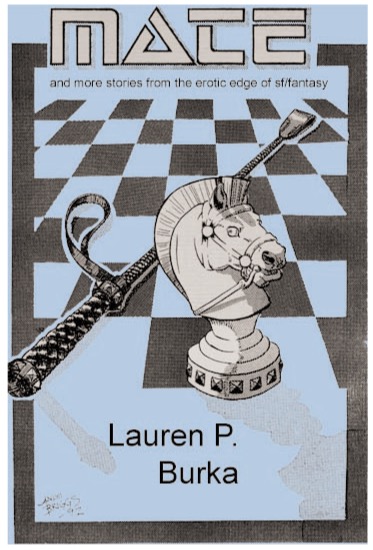
The best piece of cover art I ever got was probably the cover for my first chapbook, Mate, published in 1992. The artist worked for free. I fed her an idea, and she ran with it. I got one phone call from her. She asked me, “Mind if I have some fun with the horse?” I told her to go for it (if people are doing things for you for free, you don’t feel like you can ask for much). She sketched the chess knight and the riding whip, and bolstered the details with the press-on stuff made by Letraset that everyone used to use. You can check out the attitude on that chess knight’s face on my web site. I have the knight and whip as a tattoo on my left arm. I remember the cover artist’s eyes opening very, very wide when I showed it to her. “Yes,” I said. “I will have your art on my body when I’m 90 years old and everything sags.”
Nota Bene: The artist who rendered the tattoo was, in fact, an artist, a highly-regarded, well-known one. She made some notable contributions, such as flipping the art left-to-right so that the horse would be facing front. This is the kind of detail that an artist notices, and why she was worth every penny.
For reasons that I’m about to get into, I’m unlikely to have cover art that I want on my body ever again. I’ll be lucky if I ever get cover art that I can look at without feeling embarrassed.
The reason for that is that the industry has decided that the way around the expense and bother of using human cover artists is to use AI generation. Let’s be clear on what this means.
There is no such thing as artificial intelligence. When I was in grad school in the 90’s, the word was that AI had been just around the corner for so many decades that researchers were advised to take whatever they had and call it AI or lose their funding. That’s an ongoing process.
Now we have large language models built out of surplus graphics cards sold off by failed crypto firms, using truly astonishing amounts of water and energy, sucking down all the Geritol ads, rocket ships, moths (for some reason moths are really in for book covers right now) and breastily boobing bikini babes that have ever been used to illustrate a cover and spit out the kind of uncanny valley results that will immediately provide a source of endless amusement to readers of r/fantasyromance or other such online gatherings. Artists will point out all of the obvious AI art tells, the six fingered hands and sunken eyes, and readers will immediately conclude that the authors who use AI art for their covers do not care about their readers, that the text of the books are probably AI generated and not worth anyone’s time or effort to read. They will think the the author chose the art, because readers always think that. The discussions will be hilarious, unless it’s your book, in which case you’ll read it and burst into tears.How do I know this? It’s happening right now. Go look.
Let’s talk about skuomorphs. You know what they are. Just like early iPhones used a yellow lined facsimile of a notepad because users all (used to) know what a note pad looks like and how it’s used, just like early ceramic artists made jugs in the same shape as a hollowed out gourd because everyone knew how to use one of those, book covers these days are cast in the outdated form of something that used to be appropriate but now makes no sense.
If a book isn’t sitting on a shelf, if it’s read and consumed solely on a palm-sized device where the details are too small to see, why does everyone insist on having a human figure straight out of the uncanny valley on the cover? Who does this benefit? Certainly not visually impaired readers who are using text to speech or screen readers to navigate your books. And they’re the lucky ones, because they don’t have to see the figures with uneven eyes or cut-off fingers.I’d much rather have a book cover with a readable font that says what’s inside. I’ve heard that readers have come to expect that the more discreet the cover, the hotter the contents.
But this is just about me. If you use an AI generated cover, I will not judge. Neither will I read.